Beauty’s Sister

“Demanding circumstances,” she tells me, as we sit and eat together in the hall that is now hers, a long room made all up of books, mahogany, and red velvet.

“If I recall correctly,” I reply, “it was him, and not the circumstances, doing the demanding.”

And I did recall it, more vividly than any other time in my life. We had just come from Paris, clutching our meager belongings tight to us as we traveled down the muddy country roads. I should’ve known better than to believe my father when he told me he’d inherited a “country house,” but I suppose he wasn’t the sort of man who’d know the difference.

“It has character, doesn’t it?” He’d asked me, taking off his hat and wringing it between his hands. He smiled, nervously. I looked around the dusty floors and molding walls with my lips pursed.

“I suppose a roof is some improvement,” I had replied. I looked down to see a spider with a body the size of a penny crawling over my boot. I watched as it climbed into a small hole at the bottom of the wall like a mouse, then looked back at my father, my eyes narrowing incrementally. He swallowed.

“It’s charming,” Beauty had reassured him, beaming as she took both our hands. “I’m sure we’ll have the place together in no time.” She turned to me, her face bright. “But what first? Do you want to see our rooms? Or town?” She paused, already a little giddy. “I think I saw a bookshop on the way over.”

I want to put a lock on the door,” I replied. Her smile dimmed, and I squeezed her hand. “Perhaps the locksmiths is near the bookshop? It’s not a terribly large town.”

“Then we’ll go together?” Beauty asked.

“Always,” I replied. I chuckled as she ran to put her things upstairs.

“Things’ll be better for us now,” my father had told me. He always said that, every time he came up with a new invention, and every time he moved us around.

“Prove it,” I’d replied, and followed Beauty up the stairs.

Then there was the day that father had come home talking about a beast. I hadn’t believed him, of course, but Beauty had hung onto his every word. She wouldn’t let me talk her out of leaving, and although I hadn’t believed the story of the beast when Father told it, I believed it when we arrived at those great black gates.

“He said I’d have to go in alone,” Beauty told me, her voice soft.

“You can go in by yourself,” I’d replied, “but you won’t go in alone.”

On the first night my sister stayed in the beast’s castle, I could hear her weeping, though she was miles across the forest. I couldn’t sleep for the sound of her crying.

“You’re imagining it,” our father had said, shaving his beard in the tiny mirror he had hung above our stove. The smoky air of our little house stuck to me, greasing my hands, my hair, my lungs, but I knew I’d get a talking to if I went out that late. “And it’s much too far to go by dark – the wolves, you know.”

“Of course, Father,” I’d agreed, knowing full well that there were no wolves in our forest, and that none would be so foolish as to near a human on purpose. I poured him another glass of wine, biding my time until he fell asleep. Then I took out the map we’d been given on our arrival. I traced the path my father should’ve taken, followed it to a curve in the road. The castle he had described was not on the map, but I could see the patch of blank forest where a path should have been.

The next day I went to the library. I did it early enough that no one would notice – the French peasants did have a way of making a reading habit difficult, at least for anyone with a shred of self-consciousness. Or, as I liked to call it, survival instinct.

“I didn’t know you liked to read!” the librarian said, beaming down at me. Unwilling to admit to such a thing, I let myself smile, imitating Beauty’s tilt of head, her shy downcast glance. “Oh, but you’ve come to pick up something for Beauty, haven’t you?”

“Took the words right out of my mouth,” I replied. “We were planning on going on a walk in the forest, but we found a path that wasn’t on the map. She wondered if you might have some older books on the area?”

“How curious!” He exclaimed. He slid the ladder he stood on down the aisle, frowning. “Well, I have a few that might do–”

“Thank you,” I answered quickly. I watched the street as he piled the books in front of me. One of the village boys had taken to following Beauty home from the library, and I had as much interest in dealing with that kind of nonsense as she did. “I don’t suppose you’d mind if I went out the back?” I asked quietly. “I told my friends I’d be at home with father today, but I wanted to run just one little–”

“Of course,” the librarian replied brightly, pushing his spectacles up his nose. He winked. “Your book habit’s safe with me.”

“Thank you,” I said again. This time, I smiled without trying to.

Beauty’s absence made my day twice as long as it usually was for, as usual, our father could do nothing for himself. Between my chores and hers, I found myself working so late into the night that when I awoke, a book still in my lap, the sun was rising.

The sun was rising, and sometime in the hours before I fell asleep, I had set my finger on the right map. I prepared father’s breakfast, wrote a quick note warning him that I would be away visiting our aunt a city away, and packed myself a knapsack for the journey. In my sleeve, I carried the long thin knife I had acquired in the slums of Paris. Beauty had always insisted that she missed the city, but at least here she didn’t have to choose between one of her books and a day’s meals.

I did not find the castle until dusk. When I did, I had to suppress a shudder, for the front gates looked like nothing so much like the Gates of Hell. Not seeing any less conspicuous entrance, I reached to push one of the gates open, only to find that it had already begun to open of its own accord.

I entered slowly, wondering if I had perhaps overestimated my own abilities, and my father’s tendency to elaborate.

I did not enter the house through the main door, although I heard the knockers start… well, knocking, as I passed beside them, a rattling knock like chattering teeth. Father had mentioned the North tower – or something like – and I had come North, hadn’t I? I passed along the side of the great blackened fortress, looking for some other kind of egress. My heart leapt as I heard my sister’s voice, then abruptly sunk as I realized that she was weeping.

“Beauty!” I called. The cries stopped, and after a moment my sister stuck her head out of a window high above me. Her hair fell around her face, as lovely and untidy as ever, and tears ran down her porcelain-pale face. “Beauty, has he locked you in?”

“You must go!” Beauty yelled back to me. “It isn’t safe here!”

“Yes!” I agreed. “Exactly why you should come down! Do you have sheets? We could make a rope.” She shook her head, teary eyed, though I could tell she liked the idea. Something out of her novels, you know.

“I promised him I would stay.”

“Yes,” I acknowledged. “But you promised under great duress!” I stopped, trying to think of what would persuade her. “What if I carried you out? Surely that wouldn’t break your promise.”

“You must go,” she replied. “Before he finds you and locks you up as well.” I considered this, glad for my knife. If I wouldn’t be able to convince her while she was this upset, perhaps I could come back another time.

“And does the monster sleep during night or day?” I asked. Beauty tilted her head, confused by the question.

“He wakes from mid-day until midnight,” she answered. “And soon he will hear us, if you stay.”

“What shall I bring when I return?” I asked. Beauty opened her mouth to argue, then shut it when she saw the look on my face.

“One of my books,” Beauty answered finally. “If that will satisfy you. Now, go!”

“I’ll bring it tomorrow,” I answered. “You’ll see me soon, Beauty.”

My sister turned away, tears running down her cheeks. She shut the windows, her hands pressed against her heart. I left quickly, but not quickly enough to miss the rattle as she leaned, sobbing, against the glass.

I let the knife slip from my sleeve down into my hand as I made my way to the gates. When the knockers began to chatter I gave them a look that could’ve soured blood as well as milk, and they fell quickly quiet.

“I’ll see that beast dead,” I promised myself.

I came to see my sister every day with a different book, though I could rarely get them to her at such a distance. Some mornings she refused to come out at all, and I would read aloud to her until I heard her weeping begin to quiet. When he shut her up in her room for refusing to dine with him, I read to her from Cyrano de Bergerac, and, confident that no one but her might hear me, I gave each character a strange, silly voice, just as I had in when I had taught her to read so many years ago. When I finished the first scene, I heard a weak chuckle from the window.

“Think you can catch it this time?” I called up, my voice teasing.

“I’d rather you kept reading,” she replied. “But it is almost noon.”

“Another day, then.”

“Another day.”

She cheered a little when he gave her the magic mirror. It was the first day I found her that she was not weeping, but the idea of her eye on me at all the times was hardly reassuring. I started to sleep during the day, rather than the night, if only to gain what little time I could unsupervised. When I wept, I learned to do it the privacy of my darkened room, a rag against my mouth, and only when I knew she must be sleeping.

“Why, Sister, you must sleep all day,” she told me one morning, her mouth quirked as she traced the edges of the mirror. “Have you become nocturnal in my absence?”

“There’s no one to wake me so early,” I replied. “I’m on my way to a life of leisure. And you know I’ve never minded the dark.”

“I suppose that’s true,” Beauty admitted. She paused, then looked down at me, her eyes suddenly bright. “You know, there’s a library here twice the size of our old house.”

“Oh?” I asked. My throat felt suddenly dry. “And you like it?”

“Very much,” she replied. “So… you wouldn’t need to bring me books, anymore, if you didn’t want to,” she added. “I hate that I cause you so much trouble.”

“No trouble at all,” I answered. I took a deep, slow breath. “Perhaps you could lend me a few, then. If there’s anything you… think I’d like.”

“Of course,” said Beauty. “I didn’t know you liked–”

“If you like it, I like it,” I said quickly. “I’ll be back tomorrow, Beauty.”

I left before she could argue, a cold wind pushing me through the front gates.

Soon, of course, she began to smile again. And sigh. She spoke of the beast constantly, and though I occasionally got a word in edgewise about our father or the village, I was hardly blind to what was happening. I read the books she gave me only to have something to talk about her with, though even then her thoughts always returned to him. I began to drink, always at least an hour after midnight, when I knew she would be well on her way to bed; and on one of those nights, I must have said the wrong thing to Father. I cannot remember what it was, now, only the look in his eyes as what I had said settled in. He looked as though I had cut open his heart and lain it on the table to feed to him.

“How could you be so cruel?” He asked me, his voice wavering and his eyes wet.

“If you wanted better, you should not have sold your better daughter,” I answered, and poured myself another glass.

The next day was the day they put him in the madhouse. And the day after that, I had, at last, what I had wanted: Beauty returned home, though even I could see that she no longer had any desire to be there.

“It’s true!” She’d cried as she’d fought against the crowd, the mirror snatched so quickly from her hands that it nearly broke. The man who’d followed her all those days had given me a look, then, as though to say, “you, at least, are a part of none of this bookish, intellectual silliness. You, at least, will see reason.” I had nodded, my jaw set. Then they had begun to light the torches, and I had felt a surge of triumph. would be the one to rescue Beauty. The people marched because gave the signal.

The feeling did not last long, for as the villagers marched forward, out of the town, Beauty threw her arms around me. She wept against my shoulder, and I could not raise my arms to comfort her. It had been months since someone had held me, and the sheer shock of the sensation was enough to hold me fast.

“They’re going to kill him,” she’d sobbed, her slight body shaking. “I can’t… can’t lose… him.”

“Your… suitor… has left his horse in the stable,” I said quietly. Perhaps we could ride just a little slower than the townspeople, arrive only a moment too late. It would be easy to feign getting lost if we didn’t travel by the main road, and Beauty would never think to blame me for it.

I helped her to the stable, an arm around her shoulders to keep her upright.

“How will we get there before them, if they take the main road?” Beauty asked me. I stopped for a moment, closing my eyes. Then I turned back to her. I made myself smile, and she smiled back, uncertain.

“Have I ever let you down, Sister?” I asked.

“Never,” she replied.

“Then would you doubt me now?”

Beauty took a slow, shaky breath. She opened her mouth, as though to protest, then closed it. “No,” she said softly, firmly. “You wouldn’t let me down.”

I kicked the horse’s side and we surged forward, staying just off the path. Ahead of us, I could see the line of torches stretching out into the woods like the Phlegethon, the river of fire that leads into Hades — something I’d never have thought to imagine if it were not for Beauty and her damnable, silly books. When most thought of that night, they thought of the moment that Beauty had told the beast she loved him, and all his fur and fangs had fallen away, and left a prince.  I thought of the moment I’d seen the river of torches, and wondered: where did I lead my sister, then, if not back into hell?

“You do like it here, don’t you?” Beauty asks me, her voice soft. Father has consumed two plates of food, his face a brilliant ruby red from the wine. The beast sits to Beauty’s side, his hand over hers. He has been human since they were married, and so unrelentingly gentle and mild that it is almost impossible to hate him.

“Of course, Beauty,” I reply. “You’re here, after all.” The beast smiles and my father caws something cheerful and unintelligible. “But as I told you before, I really must be going.”

“Of course,” says Beauty, rising to accompany me. She glances at the beast apologetically, and I take the momentary distraction to quietly hand my plate down to the dog.

When we are outside, Beauty touches my arm. “Are you sure you’re alright?” She asks. “All alone in that old house?”

“You know I’m never lonely, Beauty. And we’ll see each other often,” I answer. “I promise.”

“Oh, well… Alright.” She hugs me, then draws away, squeezing my hand. “Thank you, for all you did,” she tells me. “I would’ve gone mad if not for you.”

“Tell him that,” I reply. Beauty’s face darkens, for only a moment, and I know I have misspoke. Then she straightens, her face softening with its usual concern.

“It would only hurt him,” she replies. I turn to go, and she takes my hand. “I love you, you know.”

“I do,” I reply, and she laughs as I make my way back into the woods. I follow the path until I am out of sight, then walk into the woods. I walk until I can barely make out the trees for the canopy overhead. Then I sit down, my back against a tree, and start to weep. I weep until there is no sun to shine between the trees, and then I rock back and forth against the cold. When the wolves start to howl, I raise my head and cry with them, rubbing my arms with dirt.

“Are you lost, dear?”

I look up, startled, to see an old woman standing in the clearing. She wears the skin of a wolf wrapped around her, a single rose in her hands. I shake my head, wiping my face dry with my dirty hands.

“Then you wouldn’t mind helping me find my way back to the path, would you?” The woman coughs, just a little too piteously. I realize where I have seen this woman before – the stained glass of the beast’s house – and begin to smile.

“That was terrible,” I tell her. “You need practice.”

“Pardon me?”

“I’ll take you back to the path,” I say. “But no funny business, and absolutely no curses. I’ve no responsibility to be nice to you, especially not after that beastly brother-in-law business. Understood?”

The woman stands straighter, her lips pursing with rueful disdain. Her hair lightens to gold as I watch, and her wrinkles smooth away into a youthful loveliness. The wolf’s skin lengthens, becoming a long emerald green dress.

“I hear they call your sister Beauty,” says the enchantress, her voice a deep, rasping alto. “I imagine what your nickname starts with a ‘B’ too, doesn’t it?” She lights a pipe as I watch, raising a single blond eyebrow at me.

“It even rhymes with ‘witch,'” I reply. “Good call on the curse, by the way. The man’s a piece of work.”

“He was,” agrees the witch dryly. She blows out a long drag of smoke and I find myself, perhaps for the first time in months, beginning to relax. I recall, standing there, that I have implicitly lied to Beauty – that I had sold the house a week before, so cramped with smoke and memories of worry that I could not make myself spend another minute inside, and now had nowhere to go. I swallow, eyeing the witch, and try to decide how to phrase my next query.

“I don’t suppose you have somewhere… I could… stay?” I ask. She frowns at me, raising an eyebrow. “It’d be hypocritical of you not to let me in… And while I don’t have a cursed bouquet to offer you… I can do you one better.”

The enchantress takes the proferred wine without looking at me, uncorking it with one long green talon. She hands me the rose, her hands now strictly occupied with the bottle of wine and the pipe.

“One night,” she says. “And you’re out of my house.”

“Agreed,” I answer. “I’ll be out with the morning light.”

And I imagine I would have been, too – had we not, by that time, started on the second bottle.

Updates!

Bienvenidos. Below we have a quick review of the last semester and an update on my plans for this one. The Word of the Week is siesta, because believe me when I say I am looking forward to mine. Maybe also tapas…

Last semester, I studied English literature at a Boston University satellite campus in South Kensington, London. I enjoyed my classes, met new friends, and had a fun time exploring the UK. I took Meet the Writer; The Literature of London; a core course, for which I wrote an essay on the work of Angela Carter, a woman who wrote feminist Gothic fairy tales in the ’70s; and a Shakespeare. I enjoyed the company of my classmates and the chance to hang out with old friends, such as Violet and Zoe, while also making new friends, such as Veronica and Dagny. I saw an incredible amount of theatre, including Mamma Mia, Phantom of the Opera, The Curious Incident of the Dog in the Night Time, Measure for Measure, King Henry IV, Jane Eyre, Titus Andronicus, A Winter’s Tale (with Judy Dench and Kenneth Branagh!), and others. I traveled the UK and Europe, visiting Edinburgh, Bath, Oxford, Cambridge, the Lake District, and Barcelona. Overall, I enjoyed my time, although London’s high prices, weather, and the program’s small size limited my range of activities more than I would have liked. I also started a daily writing habit in London which I have resolved to continue in the New Year – 500 words a day, every day. We’ll see how I do.

I returned home for Christmas. There, I spent time with my mother, my sister, my sister’s boyfriend, and – perhaps most importantly – my dog. We showed off the Bay Area to my sister’s boyfriend, visiting my favorite small town of Half Moon Bay. I visited with old friends, cleaned my room based on the Konmari method (well, Konmari lite), started the television shows The Musketeers and Black Books, and worked as a preschool teacher.

This morning, I woke up bright dark and early to get ready for my flight to Madrid. In less than day, I will arrive and meet up with the others in the program to receive my two-day orientation, after which I will meet my host family and be directly immersed in literature courses at a local university. I will also visit Lisbon, Portugal, with my lovely friends Danial, Kyle, Giselle, and Kamara, who I have not seen for… Well, it’s been too long. I am very excited to see them again, and I am curious as to how they have changed while I was gone.

I am nervous. I am excited. I am… not as caffeinated as I’d like to be. It’s time for the next adventure, and it’s the most challenging one so far. Not only am I starting out in a new place, this time with no one at all I know, but I will be speaking in another, unfamiliar language. I’m excited to see what I can learn and how I’ll grow, but I also know that no one ever grew without getting uncomfortable, first.

As I leave, I am reminded of how lucky I am to have the friends and family that I do. Consistent virtual communication is not my strong suit, and it has become even harder in the last two years of jam-packed schedules and travel, but you have always been there just the same. Thank you.

I’ll let you know how my first days go.

L is for Lucifer: Prompt-Based Short Story

They’ll tell you about his voice, of course. Not quite a purr. Hard without being harsh, smooth without being soft. Eloquent, powerful, but never loud. They’ll describe his hair, brilliant, curling redgold, his strong arms, the white wings that jut from his shoulders and rather than producing a light of their own seem to scare the shadows away. They might mention the ash on his high, white cheeks, or the way that paint crawls up walls as if running when he passes it. When he’s showing off, at any rate.

Tithe Night, when all the city lights are left unlit. I walked the city streets under a clouded night sky, tears running from my eyes, and sat on the corner of the crossroad. I could still see the circus lights gleaming in the distance, but I had lost the boy who followed me half a mile ago. My feet ached from running on gravel, and I pulled one into my lap, eyeing the dirt with disdain. Perhaps it would be best to return to the castle and wash there – even if there were yet a few hours before dawn.

“Lost, Miss?” A voice asked, not harsh or soft. I looked up to see a pair of scorching violet eyes glowing in the dark and tilted my head, smiling slightly. A gentleman in something like a nobleman’s suit stepped from the darkness, a smug curve on his mouth.

“Never,” I replied. “Are you?”

“Never indeed,” he replied. “You’re not scared?” He added, his head tilting just so, inquiringly.

“Never that either,” she replied. His smile widened.

“Then why are you weeping?” He asked, raising a single dark brow.

“I… may have made a bit of a fool of myself,” I admitted, sighing. “I was trying to show off.”

“Pride doth come, all that,” he agreed, sweeping the dust off the seat beside me and settling down there. “What were you doing, then?”

“Juggling knives,” I replied.

“Oh?”

“And then I got distracted by a boy,” I continued. “It just nearly missed his head.”

The man wet his lips. He sucked in his cheeks and lips, clearly trying not to smile.

“I could’ve killed him,” I informed the stranger. “I don’t think him or Selene are ever going to speak to me again.”

“Selene?”

“My best friend,” I replied. “Sort of. She’s the only person who isn’t paid to stand me and does it anyway.”

“I see,” he paused. “You’re the princess, then.” He eyed my bare feet. “You’re the princess, and you’ve… snuck out. On Tithe Night.”

“Well, it ain’t like I’m superstitious,” I said. “And even if the devil did used to come, he hasn’t come for hundreds and hundreds of years. It’d be stupid to be afraid.”

“Not that you’re ever scared in the first place.”

“Fear is a useless emotion,” I agreed. He chuckled.

“You know, you are the only one I’ve met here who could meet my eyes,” he said absently, eyeing the night sky. “Everyone else looked down, as soon as they saw me. What do you think of that?”

“Maybe they’re embarrassed,” I suggested.

“Why?” He asked. “Have they all done something wrong, and I remind them of it?”

“Maybe just… Because you’re lovely,” I replied. The man’s face twitched for a moment then, in something like bemusement.

“Lovely?” He repeated. “Really?”

“Magnificent?” I offered. He nodded. “But also lovely. I usually look down when I see lovely people, too, but you looked much too interesting.”

“And what would you do,” the stranger asked, “if I were the devil?”

I thought, long and hard. I pursed my lip and chewed on it for good measure.

“Ask for your autograph, I s’pose,” I replied. “I’ve never met someone famous before.”

Again, the man restrained a smile. “I can give you that,” he decided, thoughtful. “But there would be a price.”

“Is it my immortal soul?” I asked teasingly. His eyes danced.

“Not exactly.” He reached out, one of his fingers glowing a brilliant red at the tip like a branding iron. I leaned back, putting up a hand.

“I don’t think—”

“Lilyan!”

Flo stumbled down the street, his cornsilk hair streaming behind him. He had finally caught up, and I felt myself blushing again, the same sick feeling in my stomach. I crossed my arms and screwed up my mouth, my eyes narrowing.

“I already said sorry!” I snapped as he slammed into me, forcing his body between mine and that of the stranger.

“You stay away from her!” He said breathlessly. He looked up to meet the stranger’s eyes for only a moment before his eyes snapped down to the ground. His legs shook. The stranger rose, all smiles.

“And would you be the little princess’ victim?” He asked, offering a mocking half-bow. Flo swallowed, shivering against me. He reached back to put a hand over mine. The stranger tilted his head. “And you’re not what you appear to be, are you?” He reached forward to touch Flo’s face and for just a moment I saw something else where Flo should be, something… dark, and twisted, and fierce, a feathered face with teeth like splinters.

“You… don’t… scare… m-me,” he hissed, though I could feel his hand, wet with sweat, shaking in my own. The man raised a single eyebrow, then returned his attention to me.

“A pleasure making your acquaintance, Little Princess,” he said, offering me a full bow. I smiled at him.

“It was a pleasure meeting you too, Sir,” I replied. “Though I didn’t catch your name.”

“I’m sure your friend will help you guess it,” he replied. “And I already know yours.”

“See you around, then?” I offered. Flo squeezed my hand hard enough that it hurt, throwing me a look I didn’t quite understand. His eyes had the flat, empty look of a bird’s, and I stared at him a moment, unsure of what I saw. His hair lightened and thinned as I watched, and I noticed that his teeth were sharper than they’d been before.

“Count on it,” the stranger replied. He grinned at me, a striking, feral grin, and offered me his hand. Flo tried to stop me but I let him take my palm in his, his fingers hotter than I could have imagined, and press his soft lips against the back of my hand. “I can’t wait to see how you turn out.”

“I’ll try not to… disappoint,” I said, but he was gone as soon as my eyes rose to find him. I looked around the square, surprised by his sudden absence. The torches caught fire as I watched, lighting from the square outwards, and the clouds began to move from the moon. “What a lovely man,” I murmured.

“That was the devil, Lilyan,” Flo whispered.

“Nonsense,” I replied. “He seemed perfectly pleasant.”

“Lilyan,” Flo hissed. “He was going to take you as the tithe.”

“Why would he want me?” I asked. Flo turned slightly, just enough to look at me, and raised a single eyebrow. “And… why did you… save me?”

“Why indeed.”

Flo sighed, brushing back hair which was once again the color of cornsilk. His hand stayed on mine as he walked me home, back to the hidden door on the side of the castle. I hugged him tightly before I went in, enjoying the thick, warm scent of him. Flo always smelled the way I thought that home should.

“Goodnight, Princess.”

“I really do prefer Lily,” I told him. My face felt warm, so I shut the door more quickly than I should have. I opened it again, blushing, to peak outside. Flo smiled, then paused, his eyes narrowing.

“Your hand,” he started. I glanced down, frowning, as he took my hand in his. “I thought I saw… Never mind.” He shook his head. “I’m imagining things… Goodnight, Lilyan.”

“Goodnight, Flo,” I answered. This time, I let the door close and looked at my hand in the dark. I could see it now, too – a single, curling L.

“Oh, hell,” I muttered, and the word seemed to make the mark glow just a little bit brighter.

The Poison Tree

Part I.

I remember wandering through the Dickens museum. Back in my BA days, before I went JD and corporate. (Then mental institutes, for the depression. Rehab, for self-medicating the depression.) Some time in November, when the leaves fell and winter let out a slow, tentative breath. I remember the sky a pale grey, so uniform it seemed more like slate than cloudcover. I followed his life through the museum, past china cups I envied, a wine cellar I considered raiding, until finally I came to the top and found a portrait. An empty chair, wooden, a week after his desk. Where is he? — the chair, or perhaps the artist, seemed to say. Too realistic to be poignant, too precise. When it comes to suffering I prefer Van Gogh. For depression, Picasso in his blue period, before he learned to sing through the paint. For rage, Pollock.

Would they call this a form of art, I wonder?

Her rocking chair lies in splinters across the porch, untouched by the fierce New England wind, as fierce as the woman who used to sit there, in that chair, her hands lined and veined and so gentle, so firm, so cruel. I resist the urge to sit in the chair, although I know, can see clearly, that it has gone. I enter the house via the backdoor, still unlocked from my last, careful entry, take the broom, and began to sweep the front porch. Is it guilt? I cannot help but think that she would have preferred it without the mess. Perhaps that is why I do it. To please her.

I enter the old house cautiously, though the old fear does not remain. I pass a dark shape and turn in horror. The dark spot, where the mirror used to be. I close my eyes. Blood, still on the corner of the mirror. I decided it would be best to unscrew it from the wall, dump it where it and I could not be seen or connected back. I open my eyes. Gone. I can still smell the lemon in the air from my attempts to scrub it, to hide the overpowering scent in the air.

Sirens. I close my eyes and pray. Who to?

I realize I have left the remains of the rocking chair on the porch and double back. We can’t have a sign of a struggle now, not with the police coming around. I walk out front, watch them as they pass across to the house across the road. I can hear it now: the whooping and EDM bringing me back to my college days. I smile and wave at the police officer as he steps out and I smile and wave and he gives me a curt nod, an apologetic raise of the hand. Law and order, you and I Sir. Of course he wouldn’t suspect. We’re far out enough in the ‘burbs that lawyers do have a good name. A couple miles North and you’re in Hell frozen over, I suspect. I double-check the slant of the door, check the cracks for anything that might remain, step back inside. The earth never seems to swallow you when you want it to, does it?

I start on the liquor. Nothing else to do. I’ve covered everything that the forensics could get their hands on, and it’s not like they could connect it back to her. It wouldn’t make sense. Again, I pray. Pray. Whatever. I am on the ground in the living room, where the chair once sat. I have poured myself three shots of whiskey and a Blue Moon to start myself out. Of course the woman would have the fancy beer. I smile, in spite of myself, then cover my eyes with my hands. Perhaps I should add holy water to the mix, just in case. If it wasn’t water that started the whole of it. I listen for the creaking of the pipes, the sound of… Nothing.

Proposal: a water spread disease. How far does it go? I realize I have no idea, but poison a reservoir and what does it go through? What process of sanitation, I mean. What would you have to do to affect a town? To destroy the evidence? Or would you call this more of a local problem.

I hear the rattling again and cover my eyes with my hands. There we are, I have my god: whoever will make the duct tape hold until morning. Good God, God of duct tape, I raise my dead mother’s beer to you.

I take a swig. I contemplate the caffeine situation. Then I call a friend in town.

“Mind if I sleep over?” I ask. She chuckles, starts to make a joke, and then my tone hits.

“You alright?” She asks. I shake my head.

“I… No, no, not at all,” I say.

“You drunk?” She asks. “Thought you quit drinking after… well, you know.”

“Save me from myself?” I ask. I laugh hoarsely.

“I’ll be right over,” she starts.

“No,” I say quickly. “I–Meet me at the Starbucks, midtown. I need to sober up before seeing you.”

“You sure you’ll be alright?” She asks.

“No,” I reply, and hang up the phone.

I waited for the cop to drive away, or… the two cops? Okay, overkill on the drinking. It had been too long, and I wasn’t as big as I’d used to be.

I leaned against the wall, took a breath. Then I walked down the long dark stair to the basement. Scratches at the door, hisses. I grabbed the kerosene from the closet to the right of the main room, walked deliberately up the stairs. Out of her duct tape already, then.

I spread the kerosene from room the room, careful to cover everything I could. I was grateful the house was only a single story, old, rickety, on its way out. I covered it, walked out to the front porch, and dropped my lighter. Whoosh.

It spread a little, but the harsh wind was a wet one, too. It wasn’t catching. I took the kerosene around the sides, helping it out when nothing else would. The flames grew bigger, unstoppable, the timbers shrieking with moisture. I could hear screaming, more like an animal’s scream than an old woman’s. I stayed longer than I should have, but I needed to see it burn all the way down. If there was one thing I’d learned from the last few years, it was that running never worked. Better to catch up with what was chasing you before it caught up with you. Best to meet its eyes, let it remember that you, too, knew how to chase. To kill.

She rises from the fire. Spreads her arms like a phoenix’s wings and for a moment her eyes meet mine. A brilliant and piercing green, like a granny apple. I reach back for my gun, but stop as I see the fire cut deeper, the arms start to lower. I don’t need any more forensic, especially considering how recently I purchased the gun. How I purchased the gun.

Her body burns away, dust to dust. Soon it begins to rain, a cold heavy sideways rain that numbs my nerves. I have the urge to sit down, to let it rain down on me. Decomposing like a field mouse in the well out back. My phone vibrates. I check it, see the note of concern. I start walking down the road just as she, my Jane, pulls up.

“Your house!” She yells. I nod, silently, and pull myself into the passenger side. “What the hell happened? How come nobody called the cops?” Because they’d already been called, and sent everyone home who might’ve stayed awake to see.

“She lit it,” I said. A white lie, but one she might believe.

“What?” Jane asks. I press my face against the glass, hoping the chill will numb me.

“Burned the damn thing down.” I say. Jane pats my shoulder, weakly. We stop for coffee and she helps me as I drunkenly stumble to a seat.

“You start drinking before or after the fire started?” Jane asks.

“Before,” I reply, realizing I can’t back up after. “She was acting crazy, Jane,” I add. I don’t know how to cover myself, not in a situation like this, but she seems to believe me. I cover my face in my hands.

When lying, it’s best to include part of the truth.

“I think she’d gotten real sick,” I tell Jane. “She kept saying there was something in the water. She’d… act differently, after she drank, and she said her caretaker kept saying she should drink something.”

“Her caretaker?” Jane asks.

“She said… an old man who came by?” I say. Jane looks at me blankly. I feel my stomach sink. Green eyes, like a granny apple. “There was a man taking care of her when I arrived,” I say, and Jane sucks in her lips. I cannot tell if she believes me. I recall that I haven’t seen him, myself, and my stomach sinks.

“She… used to say that,” she whispers after a moment. “I didn’t believe her.” Jane covers her mouth with her hand. Shock. But my Jane doesn’t cry. That much is good.

“She said he had green eyes?” I ask.

A tear runs down Jane’s cheek.

“We’ll find out,” she says. “Who he was. How he did it.”

“I think this might be out of our league, Jane,” I say. “No way to prove a poisoning, if that’s what this was.”

“We could go back to the well,” Jane suggested. “That’s where your water comes from, isn’t it?”

I swallow. “Can we wait until morning?” I ask. I know I won’t be able to sleep, so this is just cowardice, pure and simple.

“Of course,” Jane says, taking my hand. “Of course we can.”

She takes me back, tucks me in in her bed. I know nowhere’s safe but somehow, someway, I’m asleep the instant my head touches the pillow.

Part II.

We return the next day, as cops circle like lazy vultures. I avoid the scene, slinking by in Jane’s car, and drove North instead back up into the fields the long way. I drive until I thought I knew where we were — it has been a long time — then park just a little ways off the road, grateful for the lack of a slope. We hike in down towards the well. Jane is quieter than me in the undergrowth. Every few steps I check my belt for the gun. I can hear my heartbeat in my ears. Out of shape. Sitting behind a cubicle all day has done nothing for my stamina, and a small part of me wonders if she will notice. If she does, she says nothing.

The most surprising thing about the well is how ordinary it looks. We draw near it slowly. I remove my gun from my pants’ line.

“If it’s poisoned, how will that help?” She asks.

“In case we’re confronted,” I reply. In case it — whatever it is — is down there. As if I knew how to use it, anyway. I remember reading a report saying even cops were useless with guns unless they were trained for combat situations specifically. Something about the stress alters your reactions, makes you sloppy. Useless. You were more likely to have it used against you or use it against yourself than use it effectively.

“Alright,” she mutters. She leans over the edge of the well before I can stop her, but nothing happens. She just looks down. “Doesn’t look like anything out of the ordinary,” she tells me. I peek curiously, but all I see in the deep pit below are roots, roots reaching down in the dark like hands. I took a shaky breath. A shiver runs down my spine.

“Let’s get out of here,” I say. I look around, wondering where the tree that the roots connect to may be.

“I want to get a sample,” she says. My hands sweat as I pull the chain to draw up the bucket. I do not want her touching the water, but I cannot explain. I don’t know how. Maybe I really am cracking up.

“Don’t touch it,” I say.

“If touching it were enough, your mother would have been gone weeks ago,” she replies. “But alright.”

“It just seems like it’s dangerous, that’s all,” I tell her. “Better to be careful, until we know what it is, right? Or just leave it.”

“We’re getting to the bottom of this,” she replies. She frowns, looking down into the bucket. “It’s… is that sap?” I look down, see the sticky mass that has risen from the bottom of the well. It is red, thick, but too transparent to be blood.

“Jane, I really—” I start. I look around and pause. I realize why I could not see the roots were connected to. I move closer as she looks through the sap, her brow knit with confusion. I run my hand along the cut stump of a tree near the edge of the wood. When I draw back my hand it is white with ash. I rub it on the grass, tuck my hand in my pocket. A memory flashes back to me, from the time before I learned to think too much: the tree, full and tall and wild, like my mother. And the man in the…  I hear a crunch and whirl towards the edge of the trees. Nothing. I swear I must be panting. My heart races.

“You ready to go?” Jane asks. She puts her hand on my shoulder as I jump. “I got a sample. We can take it back.”

“I… I want to go back to the house,” I say, on a whim. I want her away from that sap, untouched and unhandled. I watch to see which pocket of her purse she puts it into and follow her back to the car. We drive back around, past the house. Ashes to ashes, dust to… Oh, God.

“What is it?” Jane asks.

“The chair,” I say. “Her chair.”

It’s back together. No one in it, of course, but there it is, just like it was before the fight. I close my eyes, open them again. It’s still there. I get out of the car slowly. My body feels far away. I brush past the police, move towards the chair. Uncharred, too. I run my hand along the sides, feel the new varnish. I run my hands along the bottom of the rocking chair and pause. I try to move it, but it’s cemented to the ground.

“You got a pocket knife?” I ask the officer. He nods, handing it over.

“What the hell happened?” He asks.

“I was drunk and halfway to Jane’s by the time I heard about it,” I lie. “But I think the Old Lady did it. She’d been acting… erratic.”

“Hmm,” says the police officer. I scrape the knife along the bottom side of the chair, cutting through solid wood. I drag it up and find roots underneath, fat and heavy. I sniff them. No idea.

“I’m going to borrow this,” I say. I don’t listen for an answer, but continue cutting the chair up from the roots that have made their way into the soil, pulling each up as I do. I have no intention of risking any contamination. I pour out the last of my whiskey on the spot of earth, shaking out my flask. I light it up. The police officer looks concerned, to say the least, but why would I burn down my own house?

I push the chair into the back of the car, try to ignore the rattling sound of my teeth in my head.

“What was—”

“Bring it back,” I say. “Back to the well. I want to check something.”

“Alright,” she says. She can tell I’m cracking up, but she doesn’t want to push me. Always was kind. I wonder if I’ve imagined the whole thing. I look back at the chair in the back. Again, the shiver. I cover my eyes with my hands. A sickly sweet smell in the car as we ride, like her apple pies. Her…

I remember, now.

“A little faster,” I say. Jane looks over at me. She steps on the gas. I reach back to the touch the tree, the roots lying loose in the backseat.

I have her drive straight through the forest, promising to pay for any damage done to the car. I have no idea what makes her do it, but I must scare her. I catch a look of myself in the side mirror and realize I have the look too. Brown eyes bleeding with green in the corners. Not water in your tear ducts anymore. I swallow, close my eyes, open them again. Running away never works.

I leave the chair by the stump like an offering. Try forcing it against the trunk. Jane watches with something in her eyes like pity. When I reach for her hand I realize no, no, it isn’t pity. Just fear. My fingernails splinter in my hands, the veins discoloring. I run my hand over the stump, press my ear to it. It wouldn’t be that easy, would it?

I drag the chair over to the well, lift it above, and well a sigh like the wind in trees I let it drop. It falls, hits the sap at the bottom. There is a sound like churning, syrup and peanut butter and bones in a blend. Jane grabs my shoulder as the well starts to break down. I stumble back as the tree rises from the earth, taller and fatter and fuller than it was when I grew up here. It stretches outwards, reaching as though it would swallow us, but she drags us both back. I am coughing, green coming up instead of red, but she manages to pull me free of the expansion. It stops just short of its old trunk, its long arms drooping to touch the earth. Huge, green granny apples ripen and fall to the earth around it. My whole body shakes.

“We need to — I don’t know — get out of here. We need to — “ Jane whispers, harshly. The tree has stopped moving, finished, I suppose, for now. I reach up for an apple. My eyes have begun to cloud, but I take a bite and lie back against the earth. I wait for it to decide: take me, or let me go. I gave you what I wanted, didn’t I? I put you back together. I wonder what I might have missed. The front door, maybe. Would it punish me for that?

Jane is gone. Sunset. I must have slept for hours. I sit up slowly, looking over my skin. I take out my iPhone, go to camera and look myself over. I look human enough. I look up at the tree and wonder, rising slowly to touch its bark. A wonderful cold. I press my face against its skin, glad for the clarity of the chill.

“She was already sick.” His voice is a gentle rasp. I feel him behind me but do not look. “We only wanted to help.” I say nothing. I have never been good at comforting, and I have no intention of offering it to him of all people. “We didn’t realize… We just wanted to make her stronger. I… thought it might… fix her. If she became more like us.”

“But it didn’t work,” I say. I turn to look at him, to meet those brilliant green eyes. “It made her worse.”

“We’re sorry,” he says.

“If you meddle again, I’ll finish what I started with the house,” I tell him.

“I can’t not—” he starts, then pauses. “I won’t make the same mistake twice,” he offers. I give him my courtroom stare. “We won’t.”

“Good,” I say. I turn to go, and I feel his hand on my shoulder. Wooden, as cool as the tree. I stand stockstill.

“It would work,” he promises. “If we did it to you. You’re not sick, you wouldn’t… You wouldn’t decay, like she did. And of course, you’re not like—”

“I am exactly like her,” I hiss.

“You wouldn’t have to worry about the drugs anymore,” he says quickly. “Wouldn’t have to dull your senses down, to pretend to be like them. No more courtroom, no more bills to pay. It could be like it was before, when you were little — I could… protect you again, if you let me. You’d never have to worry about ending up like her.”

“I’m not,” I reply. “I’m worried about ending up like you.”

My father lets go of me. I have not turned to look at him, but I know the expression. Pain, but pain without understanding. I close my eyes. Of course this would all be his fault. Of course he would care more about me ending up like her than what he did to her.

“I’ll be here if you need me,” he says. “And if you have children, I’ll be with them. I’ll look after them.”

“Don’t,” I say. “I don’t want one more thing to protect them from.” This time I turn. I watch as he slips back into the tree, his eyes as innocent as a child’s. Ten years, and he hasn’t changed one bit. But that always was the problem, wasn’t it? I knew more about people at nine than he would at a hundred, two hundred. She had always said not to blame him, but after all this, I don’t see who else I could blame.

I walk out of the field, back to where the car should be. It’s gone. I don’t know why I thought it would remain, when Jane had gone. I wonder what her take on all of this will be, if he’s let her remember it at all.

I start walking. When a car passes, I hail it down.

“You alright?” The driver asks. I shake my head. “Where to?”

“Just get me out of the damn woods,” I say. He nods, turns on the music, and steps on the gas.

I think of the empty chair, of Dicken’s desk without him. I wonder what the house will be like, without that presence, the glaring absence. I start to wonder what my life would’ve been like with him in it, but stop myself. Some chairs stay empty for a reason.

I divide the land when I am asked to look it over. Half to be designated space for wildlife — no one permitted on it, of course. The other half I give to a developer, to work on. Some electronic club. It sounds idiotic in a town like this, but he pays good money. Now the kids can get busted in a bar instead.

“You won’t be coming back?” Jane asks.

“Visit me,” I reply. “New York City.”

“Some apartment overlooking Central Park, no doubt,” she says wistfully. I laugh. I plan on encasing myself in iron the second I get back, but no need to worry her. She hasn’t mentioned the tree, my mother, any of it. “I might join you out there,” she adds after a pause. “I’ve got an interview with a magazine next month. We should… meet up?”

“Sure,” I say. I can tell she wants to make it a moment so I shut it down, brusquely kiss her on the cheek and find a way to thank her without saying the words. She blushes. Not so brusque, then. I’m in my car before she can say anything meaningful and back on the road. The full moon is high overhead, and I know he will be out, dancing like they do. I step on the gas. I can hear the music now, loud and persuasive and wild, wild like he is. Like she was. Who knows on what soil they fed their hungry, thirsty roots.

I think of her.

I keep driving.

Pray for Paris

Who to, you fools?

Did you not read the words

of the terrorist, who cried

“God is great!”

before firing an AK-47

into a crowd?

You remind me,

with your thoughtful words

made thoughtless

by their uselessness

of Christ himself.

“Forgive them,

for they know not

what they do.”

You remind me

why I prefer Satan so:

he, at least,

does not forgive

ignorance.

God

made the world, you know.

How could anyone

forgive that?

Let us act,

rather than pray:

tell the truth

to shame the devil

(if the devil can be shamed

or were ever once untruthful.)

Change the truth

to shame God.

Untitled

I pour over stories

searching for the one

like mine, like mine

but

why, on earth, would I read

a story like mine?

Why would anyone write it?

Miserable at the start,

mediocre at the finish,

with small moments,

of glittering

magnificence.

Can I catch compassion

in paper?

Or would it run through,

run through the words,

out of your fingers,

destroying the machines

of creation.

Can I catch fear

in paper?

Or would those black letters

so closeset, so jarringly

chaotic,

so

so

so.

I couldn’t, you know.

Hard to write and harder still

to read

when you lurk in the liminal space

the limbo of becoming

a protrended leap not death defying

but death accepting.

Hard to remember a time before

we knew our echoes’

sound.

Whole

Speak the language that you know

Speak it fast or speak it slow

But do not ever bite your tongue

With words still begging

to be sung.

You are mighty — this you know —

Let your light shine — let it show!

No more waiting. No more goals.

Time, at last, to be

whole.

How to Be Fearsome

After being catcalled (or was I? They might have been yelling at the two other women on the street walking home alone at night. “Hey you! Yes you! Turn around!” and a couple of whistles didn’t really narrow it down, but was enough to make me check to see I wasn’t being followed home half a dozen times), I have decided to write a blog post on being fearsome, one of my ongoing projects. Suggestions welcome.

  1. The look is not the important thing, but it is important. It is important because when you choose to be yourself you are committing an act of agency, and that makes you powerful.
    1. The most important part of the look is the walk. Walk straight and tall, or slouch — whatever you want. But here, I must be firm, because the way you walk is how people decide if you’re a victim or not. Stay in the center of the street, away from alleys. Walk with your purse slung across your shoulders. Walk with purpose, authority, and direction. Do not walk quickly; walk briskly. Do not show fear. You are the fearsome one, not them. You could be a psycho serial killer or an ex-marine, for all these men know. You don’t need to explain to them that you aren’t, much like you don’t have to explain anything else you damn well do.
    2. Fearsome women dye their hair or they don’t. They grow it long or they grow it short or they don’t grow it at all, but whatever they do, they don’t quibble about it. They do it because they like it. They don’t care if you like it. Weirder is better but nothing at all is a rebellion, too, if it’s authentic to you.
    3. Fearsome women wear makeup or they don’t. They might wear winged eyeliner and bloody red lips or they might wear subtle makeup, because they love the way it looks or because they like the illusory effect of it, the way it acknowledges that everyone, essentially, performs themselves; or they might wear nothing at all, because they like their face just as it is or hate the feel of cream on their skin.
    4. Fearsome women show lots of skin, or they don’t. Want to wear a hijab? Go for it. Want to have your tits out and a short short skirt and a transparent top? Go for it. Nothing is as important as what you are on the inside — confident, powerful, and in control. Wear color or wear black or wear a bright pretty white. You do you, girl.
  2. How you say it is not as important as what you say, but it might as well be. 
    1. Speak your mind, but be kind — unless the people there are being dicks, then go ahead and let them have it. Examples below.
      1.  vma-gif-recap-nicki-minaj-vs-miley-cyrus-3
      2. care
    2. Speak loudly or quietly, so long as you can make people listen. If your voice quakes, or you say something stupid, keep speaking until you communicate your point. It’s okay to stop and take a break. Don’t let yourself be shamed. There’s no point in shame if you haven’t done something wrong, and you haven’t.
    3. Swear or don’t. I prefer to switch depending on context, but I think you can be perfectly fucking eloquent with swearing involved.
  3. You can’t fight the patriarchy (the world, self-doubt, homophobic BS, etc.) alone. Make friends. 
    1. It is okay to call your friends and ask them to walk with you. Having a posse is awesome. Being alone at night is tougher as a woman, but you can’t deal with people all the time, right?
    2. download
    3. ….and while anything bad that could happen would be on the perpetrator, our world is madly flawed and dangerous, we do have to live in it practically. It’s important to stay in crowded, well-lit areas, to go into stores if anyone is following you (as my roommate had to the other day), and to have a cell phone handy to call the cops or friends with. Do not go out alone if you’re planning on getting drunk. Have a buddy, and ideally an extra buddy if said buddy wants to get laid. Get each others’ numbers and check in every few hours at pre-set meeting spot. Part of being fearsome is taking care of yourself and each other. 
  4. Be powerful. Knowledge + money = power. 
    1. More education = mo’ money. Mo’ money = mo’ problems the ability to support yourself without fear. Community college is a fantastic option if you’re having trouble paying the pills for university, and should be done without any shame. It really is the most fiscally intelligent option.
    2. Educate yourself about politics, feminism, your area, money, martial arts, legal rights, dancing, etc. Follow your passion but also learn the skills you’ll need to defend yourself if something goes wrong in your life. Preparing won’t make it happen, and bad things happen to everybody. Worse case scenario, your legal, martial, (mad sexy dancing skills, writing) or financial skills could help a friend!
  5. Look in the mirror. Your face, your body, what others see, it’s just a part of who you are, and while often a wonderful part, it is not who you are. You are what is underneath the face — the history, the choices, the will that takes what it wants from nature and nurture and shapes your life. If someone fucks with you, what they’re fucking with is pure, unadulterated will. Divinity if you like, the part of you that is one with the God “I am.” If you prefer the devil to God, then call it a will as free as the devil’s, capable of shaking heaven. “Hecate,” the name of the witch goddess of ancient Greece, literally meant “will.” People are rude because they are insecure, ignorant, and less often because they are monstrous. They may look at you and say that you are less and deserve to be treated as less because of how you look, talk, or walk. But you are not these things, although these things are you. You are the burning bush, the wind that moves the sun and stars, an amalgam of the heat of the sun and the dust of exploding stars; meaty electric nanobots crackle and fire in your brain, and sometimes lightning flashes when you touch the world; the cells in your body date back to the first life, endlessly replicated and altered. As a human being, you have the ability to do terrible things. We are natural persistence hunters, and the most recent mass extinction began when we started to travel the world, eliminating each gigantic species of animal in turn. We have split the atom, altered genetic code, and we like to set gunpowder on fire and inebriate ourselves with toxic substances for fun. We are the most intelligent, adaptable, violent and creative species on this planet, and we are almost genetically identical to each other (99.5%). They tried to tell you you weren’t, because they feared you, but remember this:
  6. You were born fearsome. Everyone who has come before you, every creature that became something that would become you, has survived for good reason, and so will you. When you die you will sit in the moment of space-time you lived through like an undiscovered island, bewildering and inspiring future generations, not gone at all but distant, removed, until we crack time like we did the atom. You matter, and the matter of your body takes up gravity, sitting in the universe like a petite bowling ball in space and time. If you weigh yourself regularly, think about that: my matter stretches the universe the same way a planet does. Isn’t that incredible? 
  7. Aren’t you?

The UK So Far

To put my brain in order or perhaps simply to procrastinate, I have decided to make a list of what I’ve done so far in London, and what I have yet to do. For those of you reading who are on the London program with me, let me know what’s on your lists — perhaps we can go together.

So far, in London, I have…

  1. Eaten curry in Bricklane.
  2. Danced and drank red wine in the Cuckoo Club, then eaten KFC in Picadilly Square with new friends.
  3. Gone on the Harry Potter Studio Tour.
  4. Failed to see Buckingham Palace from exhaustion. I’ll have to get back to that one.
  5. Walked around Hyde Park with Amber, and on my own.
  6. Seen the Mousetrap. Absolutely fabulous! Go see it if you haven’t.
  7. Toured Parliament. The House of Lords was gorgeous in its scarlets and deep dark blues and gold gilding.
  8. Had a birthday party! I skyped the lovely Giselle and Rebecca, went down to a beautiful Italian restaurant/bakery, and had a chocolate cake with dessert wine.
  9. Saw Measure for Measure at Shakespeare’s Globe.
  10. Toured the Lake District, stopping at the Brontë and Wordsworth museums. We stayed up late drinking in country pubs and chatting, walked through heaths and over sheep-covered ridges, and took a boat tour of a lake.
  11. visited Danny and Chantaneu, my sister’s friends, in East London.
  12. Went to Soho with friends.
  13. Grabbed icecream and tea in Covent Garden with Amber.
  14. Went to Dinerama with some friends from my hometown in the area.
  15. Went to the London Literary Festival’s talk on the poetry of Angela Carter.

What I still need to do, and may have to find cheap alternatives to:

  1. See Buckingham Palace, damn it! Ideally well-rested.
  2. Shop Bricklane Market.
  3. Windsor Castle.
  4. Stonehenge.
  5. The London Eye.
  6. The Tower of London.
  7. Westminster Abbey.
  8. The Sherlock Holmes Museum.
  9. Resist seeing In the Heights and The Curious Incident of the Dog in the Nighttime, which both look absolutely fantastic.
  10. Definitely not buy a gorgeous travel guitar and all these feminist fairy tale books on credit. I will not. I will not. God, I wish I could work in London.
  11. Portabello Market.
  12. The Chocolate Festival?
  13. Crimson Peak
  14. Pan.
  15. Perhaps learn krav maga?
  16. Perhaps volunteer locally!
  17. Museums. So many museums.
  18. Camden.
  19. Oxford.
  20. Cambridge.
  21. Bath.
  22. Dublin.
  23. Edinburgh — for this, at least, I have flights already booked.
  24. Glasgow.
  25. Visit that detective-themed speakeasy where you have to bring in a case to get in.
  26. Phantom.
  27. Make some London friends! I may shop for clubs at the local colleges and see what looks fun, since that seems like a good way to meet people.
  28. Finish my novel, and write one short story a week, so that by the time Clarion comes along, I’ll at least be able to submit.
  29. Find a writing group to edit said stories and novel!
  30. Relax.

So there it is. A list of things I’ve done, and twice as much still to do, neat and orderly and ready to be checked off. I probably won’t get to all of it — I only have a semester — but all the same, I’m excited.

windswept

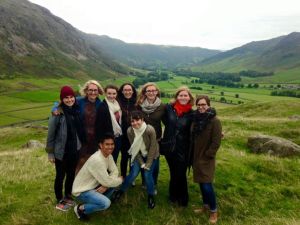
A picture of me and the lit program on our trip to the Lake District.

.